How a clogged pipeline affects heat exchanger performance
When a heat exchanger loses duty, attention usually goes to the unit itself. Yet the cause often lies partly or entirely in the pipes that supply its cooling water. A pipeline clogged with sludge and corrosion products reduces the flow, fills the heat exchanger with fragments of deposits and cancels out even a thorough cleaning of the unit.
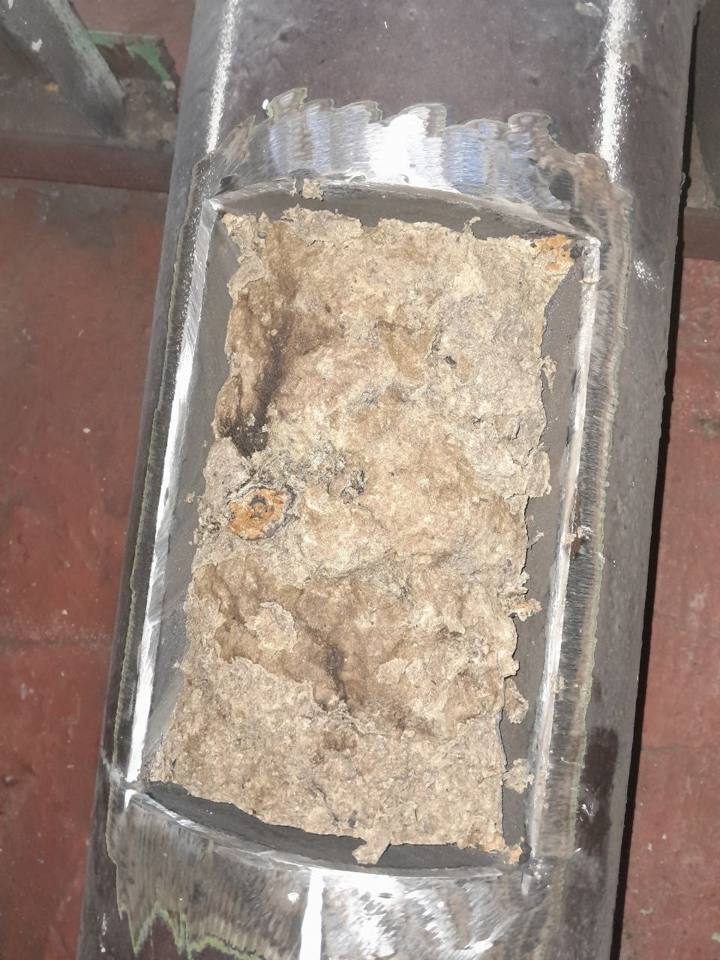
A section of service water pipeline cut out during repair: the bore is almost completely filled with sludge, scale and flakes of corrosion products.
What builds up in pipelines
- Sludge — suspended clay, sand and silt particles from service water. It settles where the flow is slow: horizontal runs, dead legs, after expansions.
- Corrosion products — iron oxides that peel off steel pipe walls as plates and flakes.
- Scale — carbonate deposits that cement sludge into a dense mass.
- Biological deposits — microbial films that bind particles and accelerate under-deposit corrosion.
1. Flow drops faster than the pipe narrows
At the same flow rate, the hydraulic resistance of a pipe is roughly inversely proportional to the fifth power of its diameter. If deposits reduce the bore by only 20 %, the resistance of that section rises about three times (1 / 0.8⁵ ≈ 3). The pump cannot make up for it: its operating point shifts and the water flow through the heat exchanger falls.
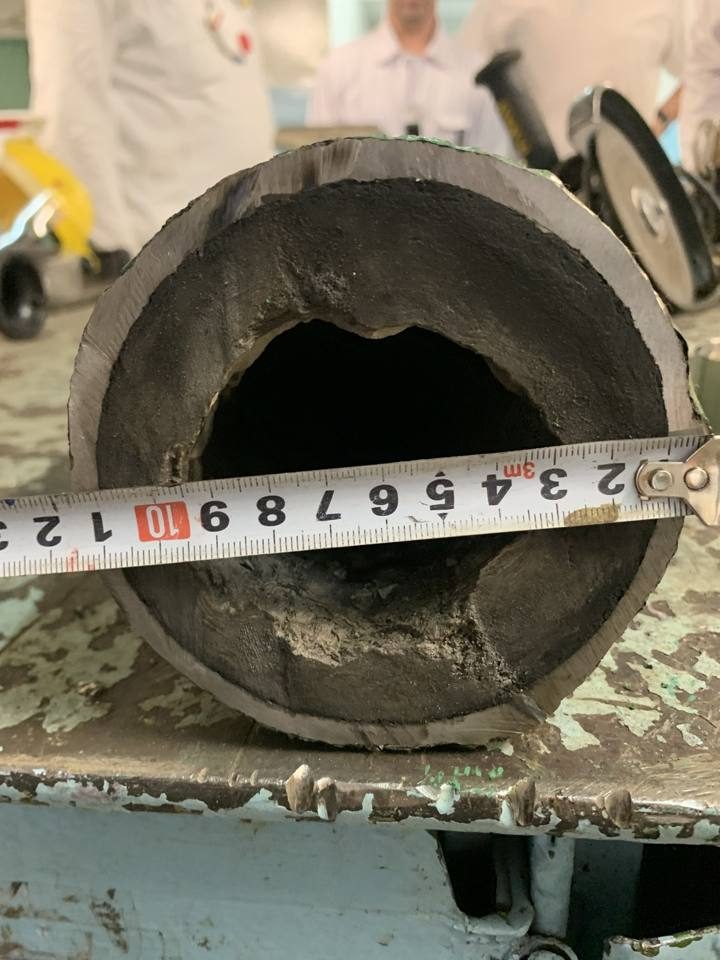
Cross-section of a pipeline with an outside diameter of about 110 mm. Deposits have narrowed the free bore to roughly 55–60 mm — only a third of the flow area is left.
For a pipe like this the estimate is simple: when the bore is roughly halved, the hydraulic resistance of the section at the same flow rate rises more than 15 times (1 / 0.57⁵ ≈ 16). No standard pump can make up for that.
2. Lower flow means poorer heat transfer
The water-side heat transfer coefficient depends on flow velocity to roughly the power of 0.8. If the flow drops by 30 %, water-side heat transfer falls by about a quarter (0.7⁰·⁸ ≈ 0.75). On top of that the cooling water heats up more, the temperature difference shrinks and the unit falls short of its duty even with a clean surface.
3. Fragments of deposits end up in the heat exchanger
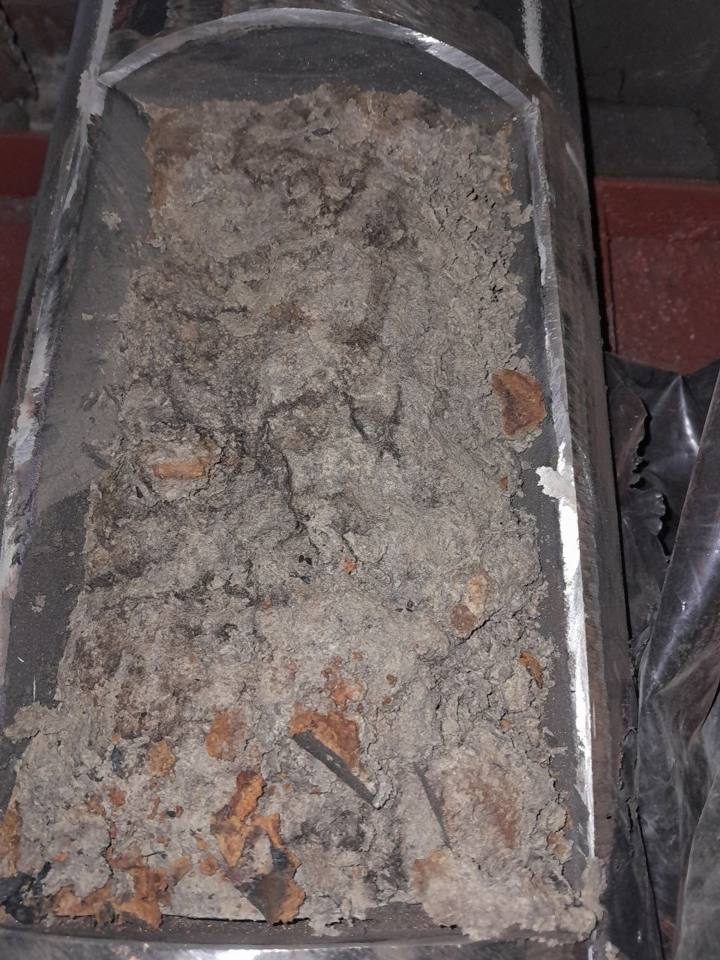
Iron oxide flakes and compacted sludge in a cut pipeline. Fragments like these break away during start-ups and shutdowns and are carried into the heat exchanger.
During start-ups, shutdowns and flow changes, pieces of deposits break away and are carried downstream. They block tube inlets at the tube sheet, plate heat exchanger channels and strainer screens. Some tubes are effectively taken out of service, while velocity and erosion increase in the others.
4. Uneven distribution between units
When several heat exchangers are fed from one header, the branch with the most clogged pipe gets the least water. One unit overheats while the others run with excess flow, and the whole system drifts off its design regime.
5. Faster re-fouling
Low velocity in a clogged pipe promotes further deposition, and fine sludge particles keep entering the heat exchanger and settling on its surface. That is why parameters deteriorate again soon after only the unit has been cleaned.
Signs that the problem is in the pipeline
- The pressure drop between the pump and the heat exchanger is above design, while the drop across the unit itself is normal.
- Water flow is below the rated value although the pump is in good condition.
- After the heat exchanger is cleaned, parameters recover only for a short time.
- Iron oxide fragments and sludge are found at the tube sheet or in the strainers.
- Parallel units perform differently under the same conditions.
What to do
The system has to be assessed as a whole: the heat exchanger and the pipes that feed it. If only the unit is cleaned, a clogged pipeline will keep restricting the flow and delivering new deposits.
CPR technology is applied not only to heat exchangers but also to process pipelines and cooling water jackets. Cleaning is done without dismantling or cutting out pipe sections, and the result is confirmed by endoscopy and by measuring flow and pressure drop before and after the work.
Conclusion
A clogged pipeline reduces flow, impairs heat transfer, fills the unit with fragments of deposits and speeds up re-fouling. The whole circuit needs to be restored — the pipeline together with the heat exchanger — so that design parameters last longer and cleaning does not have to be repeated too often.