
Microorganisms and mollusks in heat exchangers: stagnant zones and standby units
Service water is alive. Along with it, bacteria, algae, mollusk larvae and small invertebrates enter the heat exchanger. While the flow is fast, most of them pass straight through. But wherever the water stagnates, they settle, multiply and within a few weeks turn the heat transfer surface into a colony. Units on standby suffer the most: they are the ones that must start up at a critical moment — and they are the ones most often found clogged.
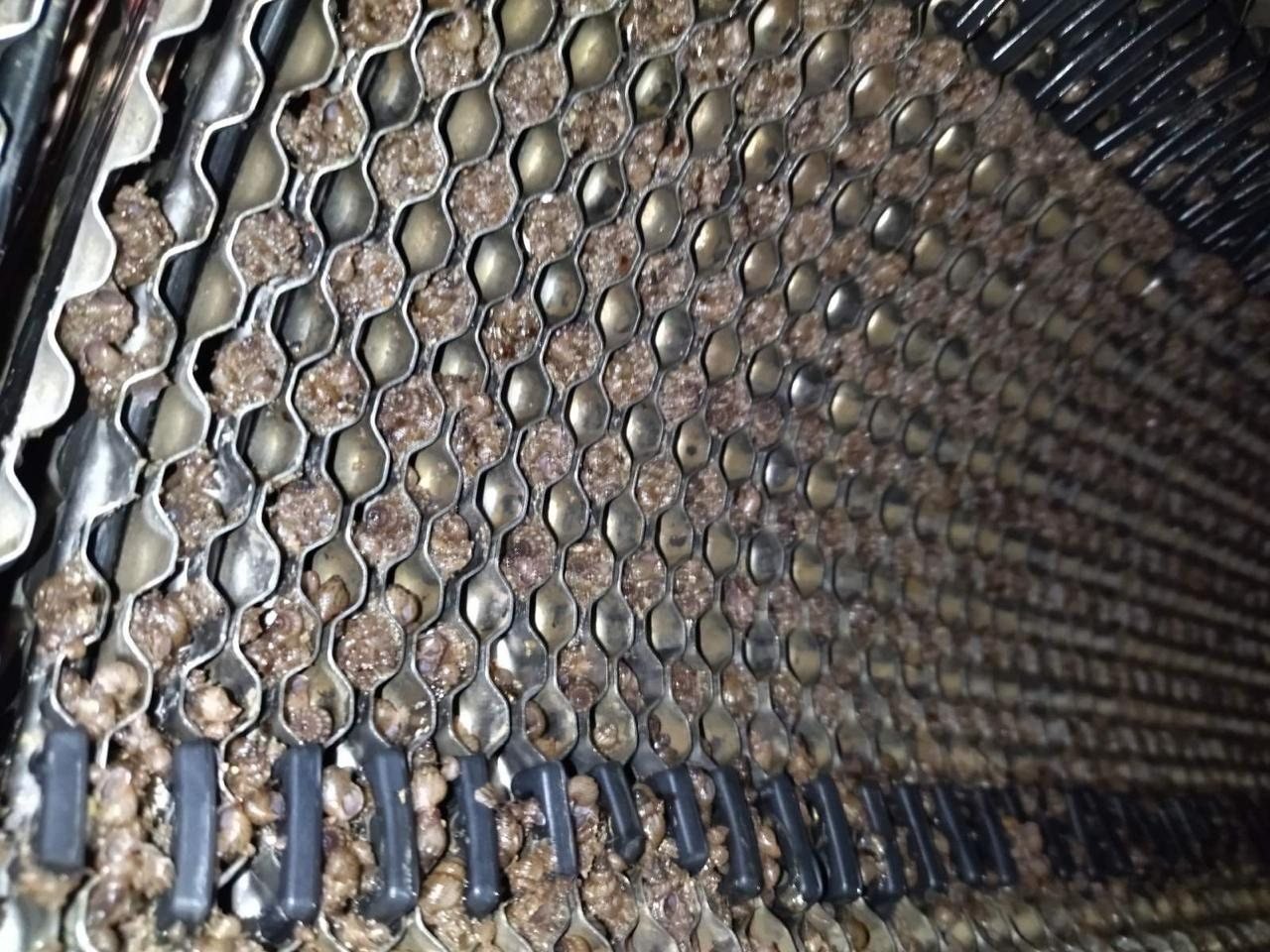
What lives in a heat exchanger
- Bacterial biofilm — a slimy layer of microorganisms and extracellular polymers. It forms first, traps suspended particles and creates a base for other organisms.
- Corrosion-active bacteria — iron bacteria and sulfate-reducing bacteria. Under the biofilm they cause microbiologically influenced corrosion: pits and through-wall leaks in the tubes.
- Mollusks — zebra mussels and small snails. Their larvae pass freely through strainers, settle where velocity is low and within one season grow into shells that block channels and tube inlets.
- Other invertebrates and algae — worms, sponges and filamentous algae that colonize existing deposits.
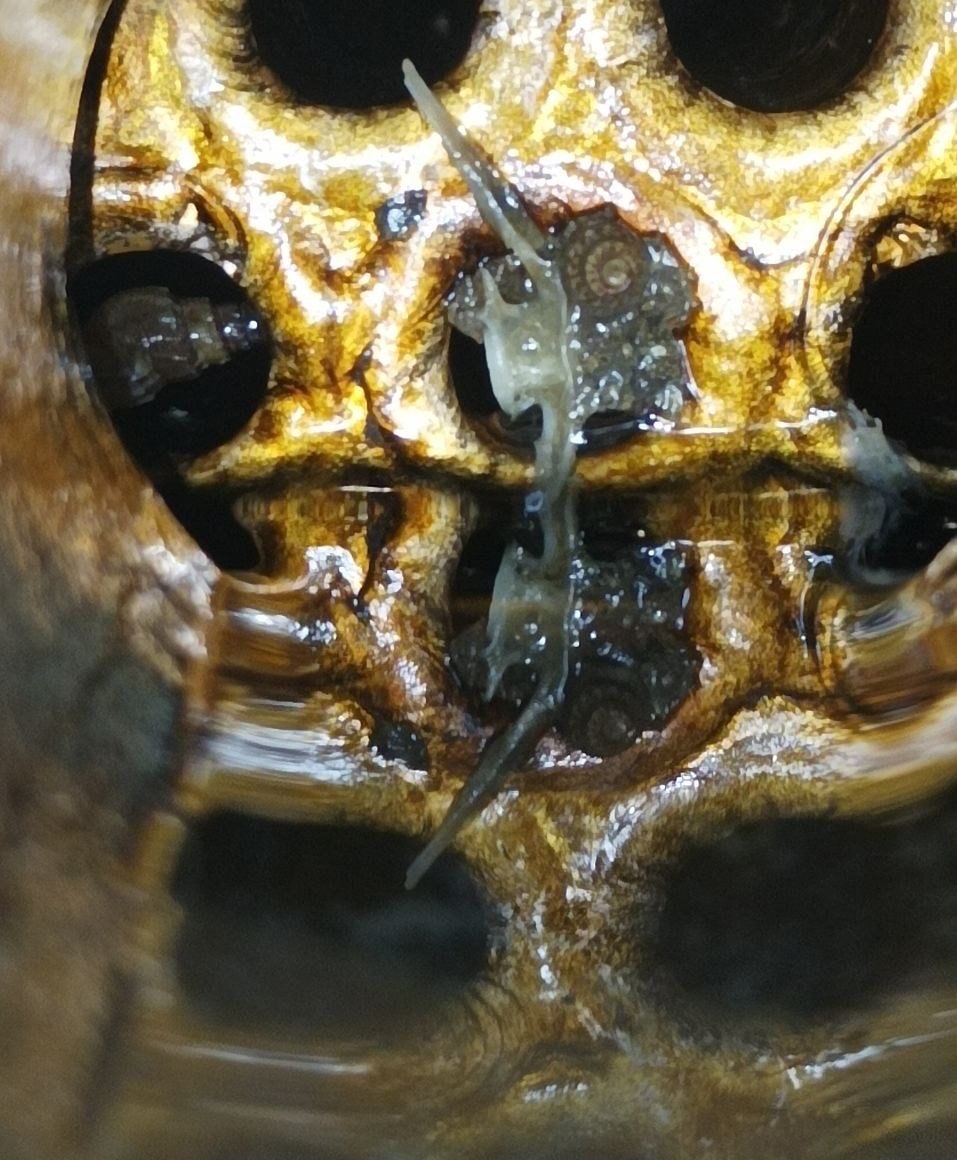
Why stagnant zones are dangerous
Biofouling is most active where water velocity falls below roughly 0.5–1 m/s: the flow no longer removes settling organisms, while warm water and nutrients speed up their growth. Typical stagnant zones:
- the lower parts of water boxes and peripheral tubes that receive little flow;
- dead legs, bypass lines and crossovers that rarely operate;
- outer channels of plate heat exchangers when flow distribution is uneven;
- heat exchangers kept on standby filled with water but without flow.
A standby unit is a perfect incubator
A standby heat exchanger is usually filled with service water, but there is no flow through it for weeks or months. Under these conditions the biofilm grows unhindered, mollusk larvae settle undisturbed and the oxygen in the water is gradually used up. Dead organisms decompose, releasing hydrogen sulfide and ammonia, which attack copper alloys and steel.
As a result, a unit that is formally on standby cannot take the load when it is switched in: channels are blocked, the pressure drop is too high and heat transfer recovers only partially.
1. Heat transfer drops even with a thin film
The thermal conductivity of biofilm is close to that of water — about 0.6 W/(m·K), tens of times lower than the tube metal. A layer only 0.25 mm thick adds a thermal resistance of about 0.0004 m²·K/W. For a water-to-water unit with an overall heat transfer coefficient of about 4000 W/(m²·K), this means heat transfer falls by more than half.
2. Channels and tubes become blocked
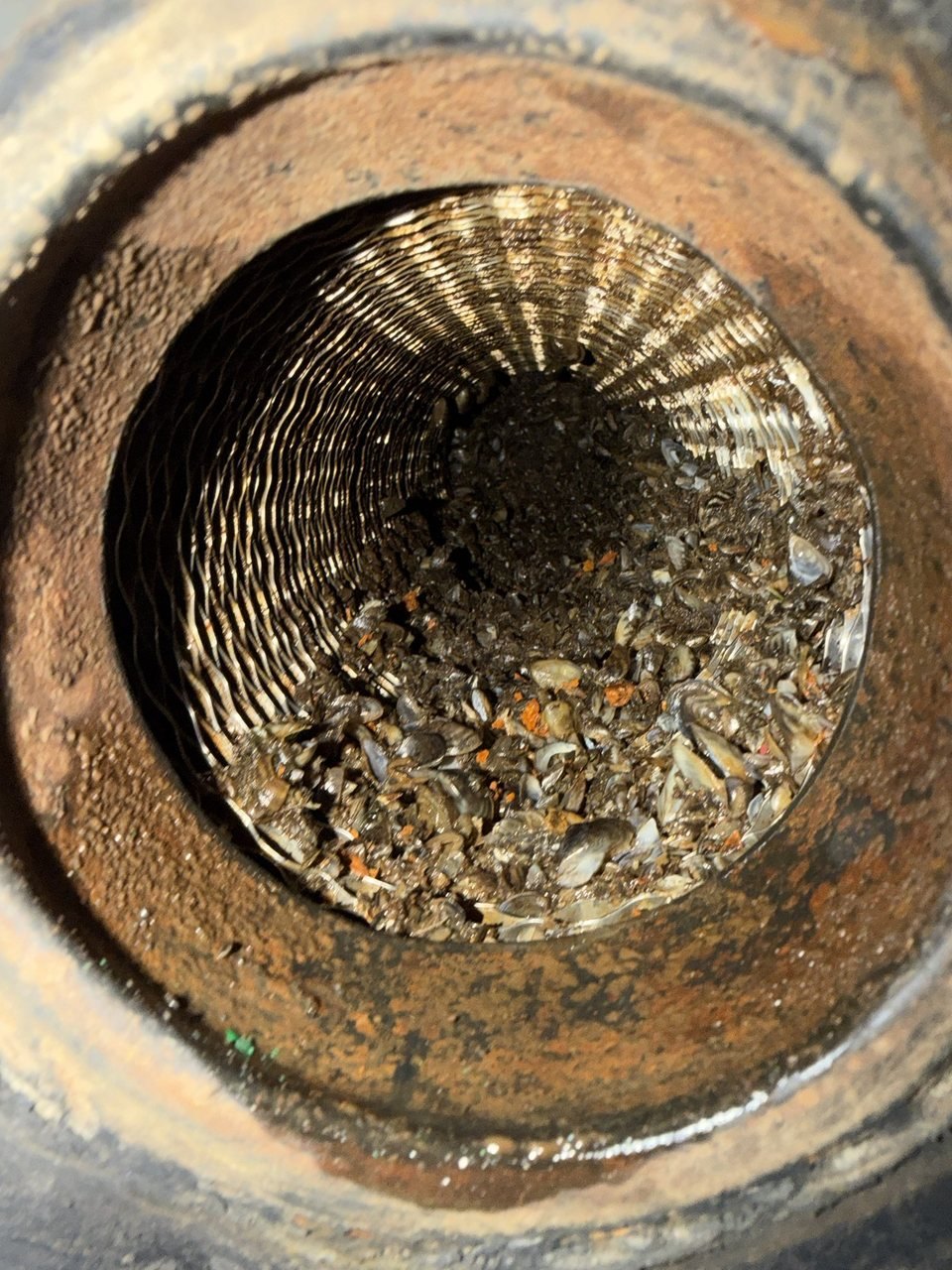
Mollusk shells and layers of biomass block tube inlets and plate channels. Flow through the unit drops, while velocity and erosion increase in the tubes that remain open.
3. Microbiologically influenced corrosion
Oxygen-free zones with their own chemistry form under biofilm and shells. This is where pitting develops, leading within a few seasons to through-wall leaks and plugged tubes.
4. A burst of debris at start-up
When a standby unit is put into service, the flow tears away part of the colony. Shells and biomass are carried into other heat exchangers, strainers and valves and clog equipment that was clean.
Shell fragments are especially dangerous. They are smaller than whole shells, travel deeper into the unit and lodge in plate channels and tubes, where the biofilm cements them in place. Such plugs are not removed by ordinary water flushing and gradually take more and more of the heat transfer surface out of service.
5. Recolonization
Biocide treatment kills the organisms but does not remove their remains. Dead shells and biofilm stay on the surface, continue to impair heat transfer and become the base for a new colony.
Why conventional methods fall short
Mechanical cleaning of a plate heat exchanger requires dismantling the pack and replacing gaskets, while in a shell-and-tube unit shells lodged in the tubes are hard to remove with rods or water jets without risking tube damage. Chlorination and biocides only kill the organisms; they do not remove the skeleton: calcareous shells and dead biomass remain in the channels.
How we restore heat transfer
CPR technology solves the problem without dismantling the unit. During chemical hydro-impulse cleaning the calcareous skeleton of mollusk shells is dissolved and the biofilm matrix is broken down, while the pulsating flow carries the remains out of the channels and tubes. Scale and corrosion products under which corrosion was developing are removed together with the biofouling.
The result is confirmed by endoscopy of tubes and channels and by measuring pressure drop and temperature difference before and after the work. The unit returns to its design parameters and is genuinely ready to operate rather than standing by in name only.
Cleaning is possible even when there is no flow through the unit at all: completely blocked tubes, channels and nozzles are gradually opened up and the passage is restored without dismantling.
The condition of the metal must be taken into account. Pitting often develops under shells and biofilm, and deposits may cover damage that has already gone through the wall. If the unit is badly worn, such spots may show up as leaks once the deposits are removed — this is not caused by the cleaning but is a hidden defect. For such units we recommend assessing their condition before the work and testing tightness afterwards.
How to keep a standby heat exchanger in working order
- Run the standby unit periodically at operating flow so that water does not stagnate for long.
- If it will be idle for a long time, drain and dry the unit rather than keeping it filled without flow.
- Inspect water boxes and tube sheets and check strainers before the season and before putting the unit into service.
- Record pressure drop and temperatures at every start-up and compare them with rated values.
- Schedule cleaning of the standby unit before it is needed, not after it fails under load.
Conclusion
Microorganisms and mollusks colonize stagnant zones and standby units most actively. They reduce heat transfer, block channels, cause corrosion and clog other equipment at start-up. Killing the organisms is not enough — their skeleton and biofilm have to be removed. CPR technology dissolves and flushes out the remains of the colonies without dismantling and returns the heat exchanger to its design parameters.